
Product Category Rules (PCRs): Product Category Rules as the basis for EPDs
Product Category Rules (PCRs) form the methodological basis for developing Environmental Product Declarations (EPDs). They define how a product’s environmental impacts are calculated, documented and presented.
PCRs ensure that Life Cycle Assessments (LCAs) – and therefore also EPDs – are developed in accordance with uniform rules, and that the underlying environmental information is more transparent and comparable.
The DIN EPD Programme supports organizations both in using existing PCRs and in initiating new rules (DIN PCRs), which are developed as part of a standardized process by DIN e. V.
What are Product Category Rules (PCRs)?
PCRs are standardized methodological rules that apply to a clearly defined product category, e.g. windows and doors, machine tools, electronic devices or glass products.
Among other things, a PCR specifies:
- which system boundaries and life cycle stages of a product are taken into account
- what data is collected throughout the life cycles (e.g. raw materials, energy, transport, end-of-life/recycling)
- which environmental indicators are calculated
Development of a PCR follows the requirements of DIN CEN ISO TS 14027 and is intended to take into account all environmentally relevant aspects of the product life cycle.
Why are PCRs required for Environmental Product Declarations?
An EPD is based on a Life Cycle Assessment (LCA). To ensure that the results of different products can be compared with one another, the same methodological rules apply to all products within a category.
PCRs provide this framework. They ensure that environmental impacts are calculated and documented in accordance with the same methodological requirements. As a result, Environmental Product Declarations within a product category become more comparable and transparent.
Only on the basis of a valid PCR can Environmental Product Declarations be developed consistently and used reliably in the market.
When is a new PCR required?
A new PCR is required if no methodological rule exists yet for a particular product category, or if an existing PCR cannot be applied to the product in question.
Typical examples include:
- new or innovative product groups
- lack of availability of a PCR for a sector
- an existing PCR does not cover the specifics of the product
Any organization, company or industry association can initiate development of a new PCR, for example if they wish to prepare EPDs for their products.
Reviewing and using existing PCRs
The DIN EPD programme offers a wide range of approved PCRs for various industries and products. These serve as the basis for the development of EPDs.
In addition, it is possible to have existing PCRs from other programmes verified and recognized, provided they meet the requirements of the DIN EPD programme.
Before a new PCR is developed, it should therefore first be checked whether a suitable rule already exists.
Show all approved PCRs
How is a new DIN PCR created?
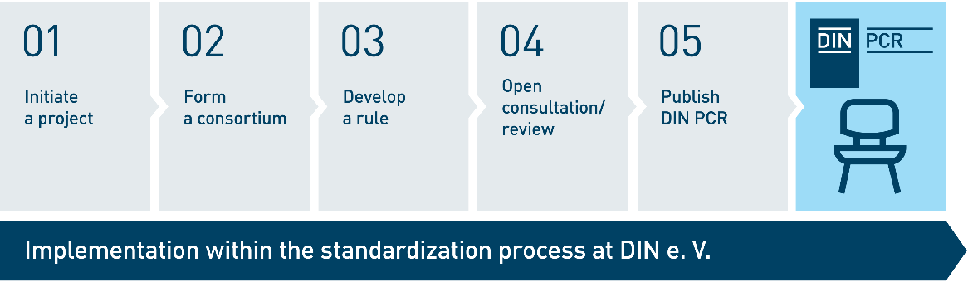
If no suitable rule exists for a product category, a new DIN Product Category Rule (DIN PCR) is developed within the DIN EPD programme. A DIN PCR is based on the template for DIN PCR development, is technically reviewed and approved within the programme, and serves as the methodological basis for the development and verification of EPDs.
The development process is part of a formal standardization process at DIN e. V. with the participation of at least three organizations from industry, academia and other interested parties.
Typically, the process includes:
- Initiation of the DIN PCR project
- Formation of a consortium (expert group)
- Development of the methodological rule
- Open consultation and review
- Publication of the DIN PCR
 Information on the standardization process, ways to get involved, an overview of ongoing projects and PCRs currently in open consultation can be found on the DIN e. V. website.
Details of the DIN PCR development process