

Developing Environmental Product Declarations (EPDs) – with the DIN EPD programme
Companies are increasingly faced with the task of documenting the environmental impact of their products and services in a transparent, credible and comparable manner – for example for international tenders, due to regulatory requirements or supply‑chain requests.
An Environmental Product Declaration (EPD) in accordance with DIN EN ISO 14025 is based on a standardized Life Cycle Assessment (LCA) and provides reliable environmental information for a product.
The DIN EPD programme provides comprehensive support to manufacturers, producers and associations in the development, review and publication of verified EPDs and Product Carbon Footprints (PCFs).
Our aim is to increase the use and acceptance of EPDs and to make statements on environmental impacts more internationally comparable.
Why EPDs are becoming increasingly important for companies
- Market access and ability to tender: EPDs make it easier to participate in national and international tenders (EU, USA, China).
- Preparation for regulatory requirements: EPDs help companies to meet statutory, voluntary and contractual environmental requirements on national and international markets.
- Transparency and credibility: EPDs document the environmental performance of your products in a manner that is comprehensible for customers, partners and the public sector. This makes purchasing and procurement decisions transparent and comparable.
Your benefits from the DIN EPD programme

|

|

|

|

|
|
Full-service approach From developing a DIN PCR to EPD development and verification |
International acceptance EPDs in accordance with ISO 14025 and EN 15804 are recognized worldwide |
EPDs for new industries Cross-sector, beyond traditional construction products |
Independent verification EPDs in accordance with ISO 14025 and EN 15804 are recognized worldwide |
Standards compliance Clear processes and up-to-date Programme instructions for reliable application |
Parts of the DIN EPD programme: PCR, EPD and PCF
The DIN EPD programme comprises central building blocks for the development, verification and publication of standardized environmental information. This includes:
- Product Category Rules (PCRs) as a methodological basis
- Environmental Product Declarations (EPDs) to document environmental impacts
- Product Carbon Footprints (PCFs) to assess greenhouse gas emissions
The individual components are systematically interlinked within the DIN EPD programme and support companies in developing comparable environmental information.
Product Category Rule (PCR)
A PCR defines the methodological requirements for the development of an Environmental Product Declaration within a product category. Among other things, it specifies system boundaries, calculation methods, data requirements and environmental indicators, and lays the foundations for a comparable and standardized EPD.
Within the DIN EPD programme, approved PCRs are used, and new DIN Product Category Rules (DIN PCRs) are developed and published as part of structured procedures:
Environmental Product Declaration (EPD)
Product Carbon Footprint (PCF)
Your path to a verified EPD in the DIN EPD programme
The DIN EPD programme provides a standardized framework for the development and publication of EPDs for products and services across all sectors. It ensures transparent procedures, independent verification and alignment with international standardization.
Standards as the basis for comparability and verification
Development of an EPD is based on internationally recognized standards, including DIN EN ISO 14025, DIN EN ISO 14040 and 14044, as well as DIN EN ISO 14067. DIN EN 15804 also applies to construction products.
These standards define the methodological requirements for Life Cycle Assessment, environmental assessment and documentation, and ensure that the results are comparable and transparent.
All relevant standards are taken into account in the DIN EPD programme and are available in the “DIN EPD programme collection”.
How to develop your EPD
We provide you with structured support throughout the entire EPD process – from the development of a DIN PCR (if no approved PCR exists) and the EPD itself, right through to publication.
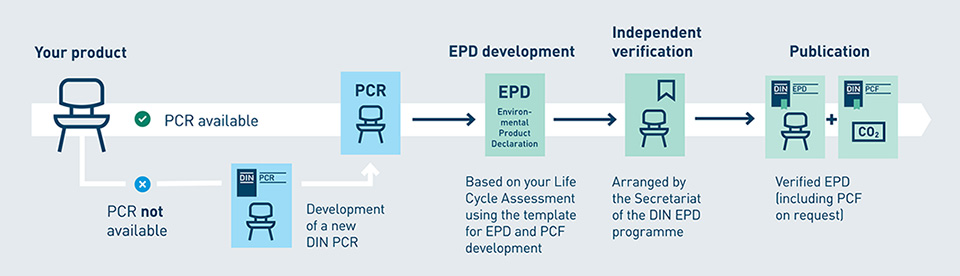
A clearly defined procedure ensures transparency, comparability and international compatibility. You, as the manufacturer, and we, as the programme operator, work closely together.
Process step | Content | Role in the process |
|---|---|---|
1. Preparation & basics | You develop the Life Cycle Assessment for your product and check whether an appropriate PCR is available. If necessary, we can support you with the development of a new DIN PCR. | by the manufacturer/organization |
2. Consultation & project launch | We clarify the requirements, assess the applicability of PCR and define the framework for verification and publication. | together with us |
3. EPD documentation | You develop the EPD on the basis of your Life Cycle Assessment and our templates, in accordance with the normative requirements. The “DIN EPD programme collection” provides you with all the relevant information to help you navigate the process. | by the manufacturer/organization |
4. Independent verification | We commission an independent verification body to verify your EPD and the underlying Life Cycle Assessment for standards compliance, traceability and plausibility. | by an external verification body |
5. Publication & provision | After successful verification, your EPD is published and made available together with the PCF in the DIN Media webshop for download as a PDF in German and English. | by the DIN EPD programme |
The time required to develop a EPD depends on the complexity of the product, the availability of data and whether a PCR already exists. In practice, the overall process typically takes several months.
Programme instructions as the basis for the process
The process is based on the Programme instructions of the DIN EPD programme, which was developed in an open consultation procedure.
Programm instructions DIN EPD
Independent verification of your EPD
Verifiers (approved verification bodies and independent verifiers) verify the EPD and the PCF for standards compliance, traceability and plausibility. This ensures that the requirements of the relevant PCR, general Life Cycle Assessment, DIN EN ISO 14025 and DIN EN ISO 14067 are met.
The DIN EPD programme defines the qualification requirements for verifiers and the verification process and specifies the conditions under which verifiers are approved. The DIN EPD programme is responsible for organizing and coordinating the verification process, meaning no additional effort for you in selecting suitable verifiers.
Frequently Asked Questions (FAQs)
-
An EPD cannot be purchased directly from our webshop as a standard product. Contact our Programme secretariat for a no-obligation enquiry to obtain information on the requirements and procedures within the DIN EPD programme. Request consultation
-
The time required depends on the complexity of the product, the availability of data and whether a PCR already exists. As a rule, several months should be allowed for the process.
-
If no suitable Product Category Rule (PCR) exists for a product, one can be developed within the DIN EPD programme. Information on PCRs that have already been approved and the development process can be found here.
-
Our Programme secretariat will support you every step of the way, from your initial enquiry right through to the publication of your EPD. The Programme is organized and managed by DIN Media GmbH, the programme operator.
Contact partner: Anna Trawnitschek
-
The costs depend on the complexity of the product and the scope of services. Entry level prices can be found in the price ranges of the respective DIN PCR and EPD services. For an accurate price, we would be happy to provide you with an individual quotation.
-
Key terms relating to Environmental Product Declarations, Product Category Rules, Life Cycle Assessments and Product Carbon Footprints are explained in the Programme instructions.